
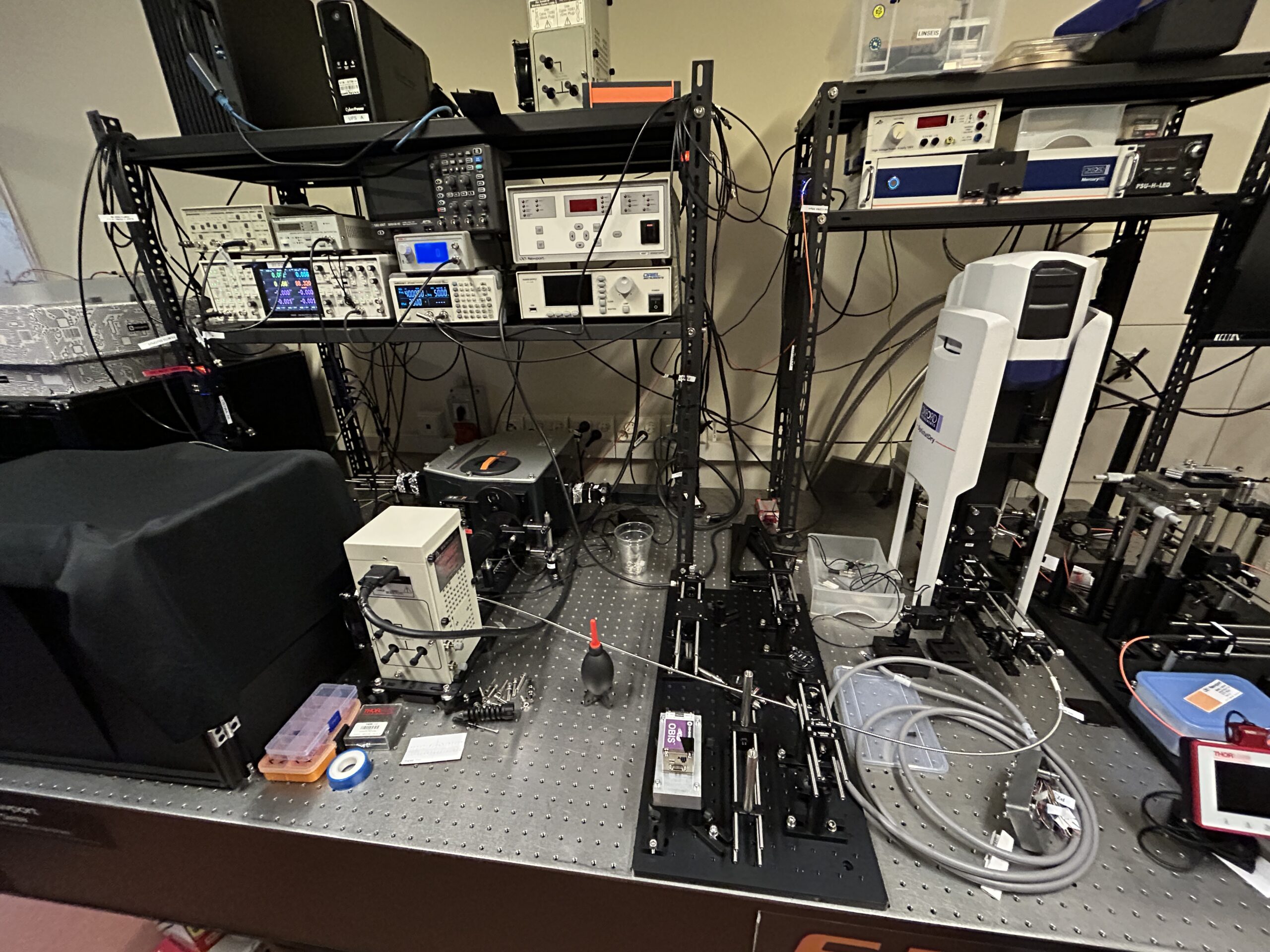
Studying optical processes in semiconductors and their nanostructures often relies on the ability to probe the density of states with high specificity and dynamic range, particularly to detect weak absorption processes in the sub-band-gap spectral region. Light scattering, coherent background signals, or sensitivity of the photodetectors often limit the applicability of conventional absorption spectroscopy based on reflectivity and transmission measurements. To overcome these, we employ photothermal spectroscopy – a family of experimental techniques in which light absorption causes local heat generation through nonradiative processes. The generated signal can be probed by a variety of detection schemes, including the photoacoustic effect (photoacoustic spectroscopy, PAS) and thermooptic laser beam deflection (photothermal deflection spectroscopy, PDS). Photothermal energy conversion enables reaching extraordinary sensitivity to optical absorbance, below 1 cm-1, useful for determining the band gap energy, the Urbach tail, and other subtle sub-gap absorption features. The measurements can be performed on thin films, epitaxial nanostructures, powdered samples, or, in the case of PDS, additionally liquid phase (colloids and solutions).
The experimental setup consists of broadband light sources: halogen and xenon lamps (Newport), covering a spectral range of 200-2500 nm. The beam is spectrally filtered with a grating monochromator (Andor Kymera) and launched to the designated optical setups for PAS and PDS, with their respective sample cells. In order to cover a high dynamic range of absorbance measurements (over 4 orders of magnitude), the experiments use modulation of the pumping beam at frequencies enabling lock-in detection (Stanford Research Systems SR860). For studying the response dynamics of the thermal field generated in the samples, laser beam excitation can be used instead of the broadband sources (Coherent Obis series, wavelengths between 405-980 nm).
The tunable light source also provides an excitation beam for photocurrent measurements, further converted to external quantum efficiency (EQE) spectra, aided by calibrated photodiodes. The laboratory developed a variety of custom-made sample holders, suitable for conducting experiments in a temperature range of 5-300 K.
Representative papers